
Archive Record
Images
Metadata
Collection |
Bruce Lisman Collection |
Title |
A Guide to the Bruce Lisman Collection |
Catalog Number |
A2024.12.0000 |
Level of description |
Fonds/Collection |
Dates of Creation |
1835-2023 |
Creator |
Hawthorne, Nathaniel, 1804-1864 |
Other Creators |
Whittier, John Greenleaf, 1807-1892 Cooper, James Fenimore, 1789-1851 |
Admin/Biographical History |
The Bruce Lisman Collection features items relating to 19th century American writers, primarily Nathaniel Hawthorne, with notable works and signed copies of James Fenimore Cooper and John Greenleaf Whittier. Nathaniel Hawthorne was born July 4, 1804 in Salem, Massachusetts. He was a novelist and short story writer, whose notable works include "The Scarlet Letter," "The House of the Seven Gables," and "Twice Told Tales." Hawthorne attended Bowdoin College in the 1820s. There, he met and befriended future U.S. President Franklin Pierce (November 23, 1804 - October 8, 1869). On July 9, 1842, Hawthorne married Sophia Peabody (September 21, 1809 - February 26, 1871). In addition to writing, Hawthorne also held a diplomatic position that required him to move with his family to Liverpool, England. They also traveled to London, Paris, and Florence before returning to Concord, Massachusetts in 1860. Hawthorne died in Plymouth, New Hampshire in 1864. James Fenimore Cooper (1789-1851) was an author known for his historical romances, depicting colonial and indigenous characters from the 17th to the 19th centuries. He was born in Burlington, NJ to William and Elizabeth Cooper. The family moved to New York before Cooper's first birthday. There, his father founded Cooperstown and was later elected to the U.S. Congress. James Fenimore Cooper served in the U.S. Navy in the early 1800s and married Susan Augusta de Lancey in 1811. He spent some time living in Europe with his family before returning to America where he died in Cooperstown in 1851. Throughout his career, he published numerous works of fiction and nonfiction, countering European prejudices and encouraging the development of uniquely American art and culture. John Greenleaf Whittier (1807-1892) was an American Quaker poet and abolitionist. Frequently listed as one of the fireside poets, he was influenced by the Scottish poet Robert Burns. He was born to John and Abigail Whittier in Haverhill, MA and lived a life of meager means. He initially paid his tuition to Haverhill Academy through food from his family farm. Later, he paid from his salary as a teacher and completed high school in only two terms. Whittier would go on to become outspoken in his anti-slavery views. A public critic of Andrew Jackson, he was also a contributing editor for the abolitionist paper The National Era. He is remembered particularly for his anti-slavery writings, as well as his 1866 book Snow-Bound. |
Scope & Content |
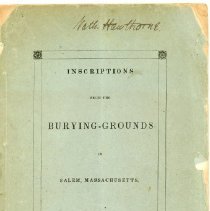
Most items in this collection can be found in the House of the Seven Gables Library catalog, with Hawthorne-signed customs house documents (A2024.12.0001-0008) and two newspapers in the Archives catalog (A2024.12.0009 and A2024.12.0010). In addition to rare and first edition copies of 19th century American books, the collection includes signed copies of works by John Greenleaf Whittier and James Fenimore Cooper, as well as Nathaniel Hawthorne's own copy of "Inscriptions from the Bury-Grounds in Salem, Massachusetts." While books in the collection can be found by browsing our library catalog (B2024.12.0001- B2024.12.0104) and are located on library shelves, the list below features more information on items stored in the archives. These include pamphlets and soft-cover or unbound volumes. |
Language of Material |
English |
Contents of the Collection |
Processed By: Erin Pucko A list of items stored with the archives. Please see library catalog for a full list of books in the Bruce Lisman Collection. Box 1, Folder 1 April 1, 1835 The New England Magazine (B2024.12.0001) Box 1, Folder 2 1837 Nathaniel Hawthorne's copy of "Inscriptions from the Bury-Grounds in Salem, Massachusetts" (B2024.12.0002) Box 1, Folder 3 1843 "Egotism or the Bosom of the Serpent" by Nathaniel Hawthorne (B2024.12.0003) Box 1, Folder 4 1838-1840 2 unbound issues of "U.S. Magazine and Democratic Review" featuring works by Nathaniel Hawthorne (B2024.12.0004-0005) Box 1, Folder 5 1844 3 unbound issues of "U.S. Magazine and Democratic Review" featuring works by Nathaniel Hawthorne (B2024.12.0006-0008) Box 1, Folder 6 1847 "The Celestial Railroad" by Nathaniel Hawthorne (B2024.12.0009) Box 1, Folder 7 1848 Customs documents signed by Nathaniel Hawthorn from his time as an official at the Customs House (A2024.12.0001-0008) Box 1, Folder 8 1901 "The Three Golden Apples" by Nathaniel Hawthorne, first separate edition (B2024.12.0010) Box 1, Folder 9 1901 "The Great Carbuncle" by Nathaniel Hawthorne, first separate edition (B2024.12.0011) Box 1, Folder 10 1902 "The Story of the Golden Touch" by Nathaniel Hawthorne, first separate edition (B2024.12.0011) Box 1, Folder 11 1904 Grolier Club Exhibition on Firs Editions of the works of Nathaniel Hawthorne Unit 1, Drawer 2 1954 "The Lighthouse from a Story by Nathaniel Hawthorne" TV Script B2024.12.0102 Unit 1, Drawer 2 1953 "Septimius from a Story by Nathaniel Hawthorne" TV Script (B2024.12.0103) Unit 1, Drawer 2 1977 "The Scarlet Letter" television movie script (B2024.12.0104) Unit 1, Drawer 2 1850 January 24, 1850, issue of Washington newspaper "The National Era," an abolitionist paper featuring John Greenleaf Whittier as corresponding editor. Unit 1, Drawer 2 September 6, 1851 copy of "The Boston Museum" newspaper, featuring article on Nathaniel Hawthorne (A2024.12.0010) |